
Understanding the Basics of Health Insurance
Costs you are responsible for as a patient:
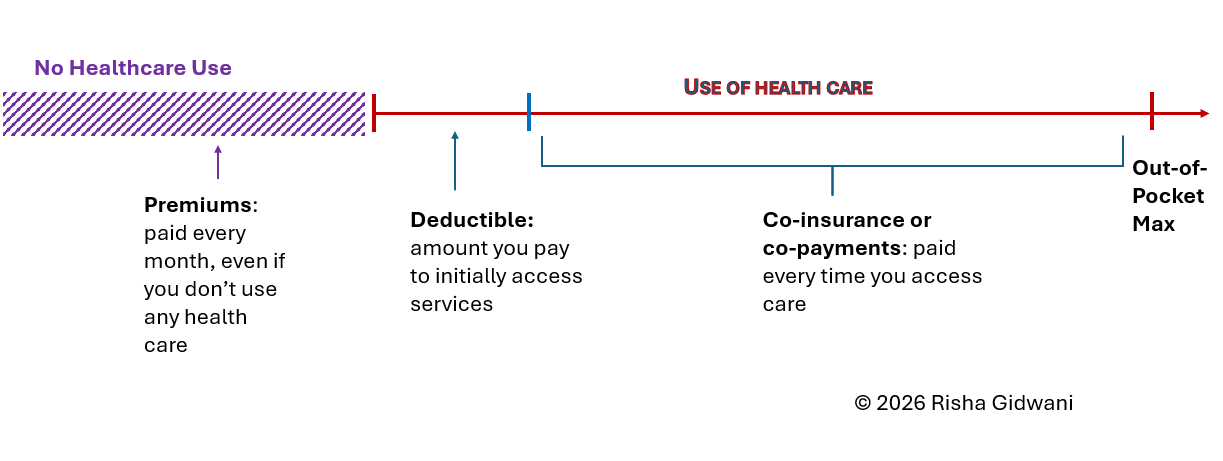
Glossary of Health Insurance Terms
Total Price
Total Price: this is the full price of a healthcare service. Depending on your personal insurance, you may or may not pay the total price. For example, if you have not yet met your deductible, you might be responsible for paying the total price. If you have met your deductible, or the service is deductible exempt, you will pay only part of the total price.”
A service will either have a co-payment or a co-insurance, but not both.
Deductible
A co-payment is a fixed amount you pay for a healthcare service. For example, if your co-payment for an MRI is $40, you pay $40 no matter how much the MRI costs.
A co-insurance means you pay a percentage of the cost of a healthcare service. If your co-insurance is 20%, you pay 20% of the cost of the service, and your insurance pays the rest. The amount you pay will change depending on the overall price of the service. For example, if the service costs $1000, you will pay $200. If the service costs $500, you will pay $100.”
The back of your insurance card may tell you whether you have a co-insurance or a co-payment for a service. Co-insurance is usually shown as a percent (%). Co-payment is usually shown as a dollar sign ($).
For example, your insurance card may say “Hospital 20%”: That means you have to pay a 20% co-insurance for a hospital bill.
Or, it may say “Specialist $30”: That means you have to pay a $30 co-payment to go see a specialist doctor.”
If your insurance card does not have this information, you can call your insurance company and ask, “What is my cost for this service?” They can tell you about your co-payment or co-insurance.
Deductible: A deductible is the amount of money you must pay for healthcare before your insurance starts helping pay. This may be something like $1000.
Deductible reset: A deductible reset means your deductible starts over again. This happens every 12 months, at the start of your new plan year. For example, let’s say your deductible is $1000 and your plan year starts on January 1. If you pay $400 for healthcare in that year, you have $600 left on your deductible. However, on January 1 of the next year, your deductible resets to $1000 again.
Deductible exempt: Not all healthcare services require you to pay a deductible first. Some services are covered right away, which means your insurance pays for part or all the service. If that is the case, the service is considered to be “deductible exempt.”
What it means to “meet your deductible”:
If you have met your deductible, it means you have spent enough money out-of-pocket on your healthcare that your insurance will now start to pay the majority of your healthcare costs.
If you are in a family insurance plan, there may be one deductible for the whole family, no matter who pays it. For example, if your family deductible is $2000, your family must pay $2000 total before insurance starts helping pay for everyone’s care.
Some family plans also have individual deductibles. For example, Mike, Sarah, and Jane are all enrolled in the same family health insurance plan, with a deductible of $2000 for the family and $800 for the individual. In this case, once Mike pays $800 out-of-pocket in health care costs, he would have met his deductible in his family plan. Insurance would help pay for any healthcare Mike has after this point. Sarah and Jane would still be considered to have not yet met their deductible.
To learn how the deductible in your family plan works, please call your insurance company.
Out of pocket max:
Many, but not all, health insurance plans have an out-of-pocket maximum. The out-of-pocket maximum is the most money you will have to pay for covered healthcare services in a year. You can reach your out-of-pocket maximum through the money you pay for deductibles, co-payments and co-insurance. After you reach this out-of-pocket maximum, your health insurance will pay for 100% of the rest of your care for the rest of the year. However, after that year ends, the out-of-pocket maximum resets.
Example: Your plan runs from January to December and has an out-of-pocket maximum of $8,000. After you have paid $8,000 out-of-pocket (through your deductible, copayments, and/or coinsurance), your insurance pays 100% of covered in-network healthcare costs for the rest of the year. In January of the next year, you start over at $0 toward the new year's limit.
Sometimes, the same doctor may charge different prices for the same healthcare service. This can happen when the service is provided at different locations, such as doing a surgery at a hospital versus an ambulatory care surgery center. You can call your doctor’s office to see where you can get the lowest price for a service.
Preventive Services:
Preventive services help keep you healthy and find problems early. Examples include yearly checkups, vaccines, and health screenings.
Many preventive services are covered by insurance at no cost to you. That means that you do not have to pay a deductible, a co-payment, or a co-insurance to get these services. However, if you receive other, non-preventive healthcare services during the same visit, you may have to pay part of the cost.
In Network versus Out of Network: In-network providers are those that have agreed to work with your health insurance plan.
If you go to an out-of-network provider, you may have to pay more than the price shown here. Always check that your doctor or hospital is in your insurance network (“in network”) before getting care.
Cost-sharing: Cost-sharing is the amount of money you are required to pay as a patient. This could be a deductible, a co-insurance, or a co-payment.
When deciding what service to purchase, you should consider both the price of the service and the quality of that service. For example, if you are choosing a hospital at which to deliver a baby, you may wish to prioritize their medical capacity such as having a NICU (neonatal intensive care unit), over the price of the service.
To find out what services are required by federal law to be $0 cost to you, click here: https://www.uspreventiveservicestaskforce.org/uspstf/recommendation-topics/uspstf-a-and-b-recommendations